
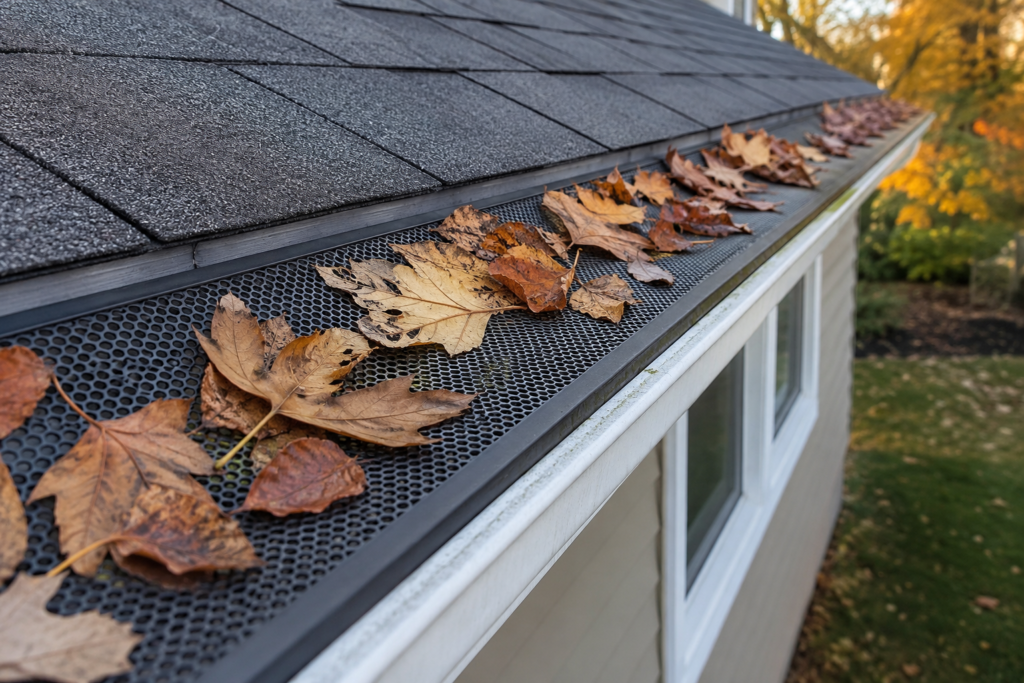
In the Hudson Valley, gutter guards tend to matter most when the leaves start falling faster than anyone can keep up with them. A gutter that looks clear in early September can be packed with wet leaves by mid-October. From the ground, it may not look serious. Then rain comes, water spills over one edge, and the downspout barely moves any water at all.
That is usually the first sign that the gutter system is not keeping up.
Leaves do not need to fill the whole gutter to cause trouble. A small layer of wet debris can slow runoff enough to send water behind the gutter, over the front lip, or down too close to the foundation. In fall, when rain and cooler weather often arrive together, that trapped debris can stay damp for days.
Why Fall Is Tough on Gutters
Hudson Valley leaf season can be heavy. Oaks, maples, birches, and pines all drop at different times, so the mess does not always happen in one clean wave. Some weeks are manageable. Other weeks, one windy night can cover roof valleys, gutters, and downspout openings before the next storm arrives.
Gutters are meant to move water away from the house. Leaves interrupt that simple job. Instead of flowing toward the downspout, water spreads through the debris and looks for another path. It may spill over the gutter, soak the fascia, or land hard near the foundation.
Wet leaves also add weight. When they mix with twigs, grit, and pine needles, the gutter can start pulling away from the roofline. It may only sag a little at first. Still, that small shift can change how water drains.
Most homeowners do not notice a clogged gutter on a dry day. They notice it during rain, when water is already going somewhere it should not.
How Gutter Guards Help During Leaf Season
Gutter guards do not make gutters maintenance-free. That is not a realistic expectation. What they can do is reduce how much debris gets inside the gutter and make heavy clogs less likely.
A guard covers the open top of the gutter while still allowing water to pass through. Larger leaves and debris stay closer to the surface instead of dropping into the channel. Some blow away once they dry. Some may still need to be cleared, but removing debris from the top is usually easier than scooping out packed, wet material from inside the gutter.
The value is not perfection. It is keeping water moving.
For homes surrounded by mature trees, gutter guards can help reduce the repeated blockages that show up every fall. They are especially useful on taller homes, steep lots, or rooflines that collect a lot of runoff in one area.
Where Overflow Usually Shows Up
Overflowing gutters can seem like a small exterior issue. The water is outside, so it may not feel urgent. But water that misses the gutter still has to land somewhere.
It may collect beside the foundation. It may splash dirt against siding. It may run across walkways or porch steps. In colder weather, those wet areas can become slick. If water is backing up near a roof edge, it can also affect fascia boards and nearby trim.
The early signs are not always dramatic. A mulch bed may wash out after every storm. Paint near the gutter may start peeling. One downspout may stay strangely dry during rain. A corner may drip long after the storm has passed.
Those small signs are worth noticing because they often appear before larger damage does.
Gutter Guards on Older Hudson Valley Homes
Older homes can be more sensitive to drainage problems. Some have rooflines with additions, dormers, porch sections, or inside corners that push a lot of water into one short gutter run. When leaves collect in that spot, overflow can happen quickly.
Shade also matters. Debris under large trees may stay damp longer, especially on north-facing areas or roof sections with less sun. Damp leaves settle into the gutter instead of blowing away.
This is where gutter guards can be useful, but fit matters. Pine needles behave differently from broad maple leaves. A steep roof sheds water differently than a lower-pitched roof. A guard that works well on one house may not be the right match for another.
What Still Needs Checking
Even after installation, gutters should still be checked from time to time. Debris can sit on top of the guards. Small material can sometimes get through. Downspouts can still clog if old buildup was already inside the system.
The difference is that upkeep may become lighter. Instead of pulling out heavily packed leaves, the work may be limited to clearing the guard surface, checking corners, and watching how water moves during rain.
After a storm, the gutter should drain evenly. Water should not pour over one section while the downspout stays dry. The gutter should not pull away from the fascia. The soil below should not show deep channels from overflow.
A gutter system usually gives small warnings before bigger problems show up.
A More Manageable Fall Season
Leaf season is never clean in the Hudson Valley. Trees drop leaves, wind pushes them across rooflines, and rain presses them into corners where they stay wet. That part does not change.
Gutter guards help the gutter system keep working during the weeks when debris is heaviest. They reduce the chance of packed clogs, limit overflow, and make routine upkeep less difficult. The benefit is quiet. It usually shows up during a steady fall rain, when the water keeps moving instead of spilling over the edge.